Photo series "Thou shalt not make unto thee any graven image"
The work consists of a series of macro photographs of the reflections of ready-made
objects, accompanied with experimental underground video art and animation.
If you were told that there is a spot in your field of view that you cannot see, even
though it is located right in front of you, you certainly would not believe it. Is it possible
that all of us have not noticed, all of our lives, such a major shortcoming in our vision?
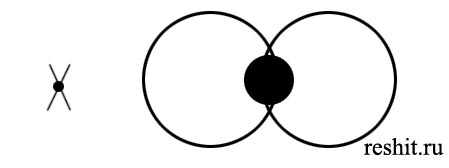
Here is a simple test that will convince you of this. Hold this picture at a distance of 20 inches from your right eye. Close your left eye and stare at the cross on the left, slowly drawing the picture closer to your right eye: There will be a moment when the large black spot at the intersection of the two circles will disappear.2
The commandment “Thou shalt not make unto thee any graven image” is a blind-spot
in the field of spiritual teachings. This is the second out of ten Biblical
commandments—it exists in Judaism, Christianity and Islam. According to Buddhism,
the only teacher on one's spiritual path is himself. Nevertheless, this commandment is
ignored or bypassed, even by orthodox believers, and there are good reasons for that.
The power of art simply cannot not be neglected by rulers.
In 1936, the great Jewish philosopher Walter Benjamin wrote, “for the first time in
world history, mechanical reproduction emancipates the work of art from its parasitical
dependence on ritual...but the instant the criterion of authenticity ceases to be
applicable to artistic production, the total function of art is reversed. Instead of being
based on ritual, it begins to be based on another practice— politics.” Nowadays, the
work of art can be exploited even more widely and efficiently, and this is what Benjamin
warns us about.
Religious symbols (the cross, the star of David, statues of Buddha, images of saints)
contradict the meaning of the word “religion”—they divide rather than unite.
The Tao Te Ching says:
When the great Way is forgotten,the doctrines of humanity and morality arise...
When family relationships are not in harmony,filial piety and parental love are advocated.
This may be paraphrased as: When the Great Teaching is forgotten, idols appear.
1 Walter Benjamin "The Work of Art in the Age of Mechanical Reproduction"(1936).
2 Jacob Perelman "Physics for entertainment"(1913)
